By Ojoma Akor
The Institute of Human Virology Nigeria (IHVN) is supporting research towards addressing viral diseases and other health care challenges in Nigeria.
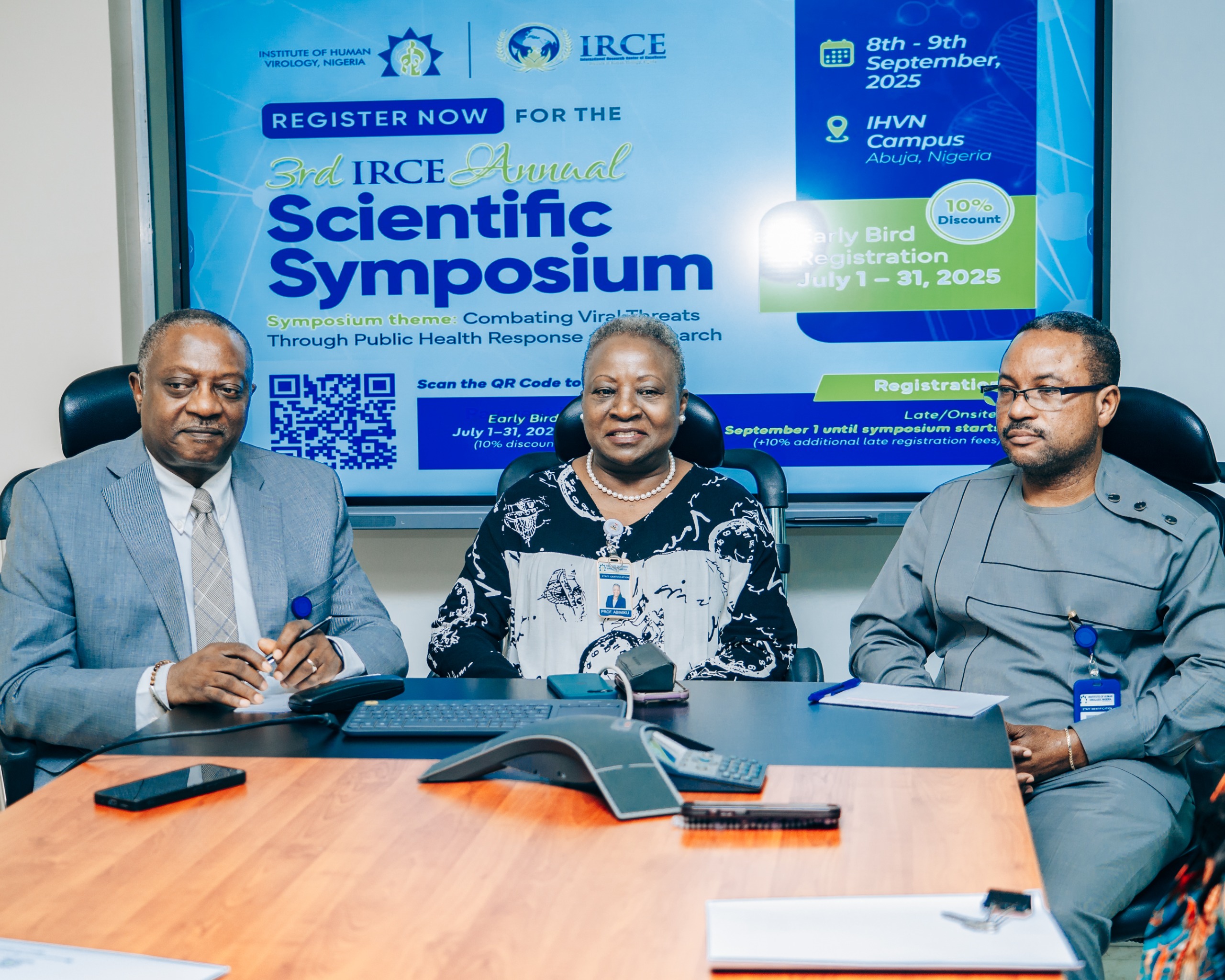
The institute disclosed this in Abuja during a press briefing ahead of its third annual scientific symposium.
The organization said one of the ways it is advancing research is through its International Research Center of Excellence (IRCE’s ) annual symposium.
This year’s symposium holds on 8th and 9th September, 2025 with the theme, “Combating Viral Threats through Public Health Response and Research.”

IRCE Executive Director, Prof Alash’le Abimiku said the annual symposiums have focused on themes that highlight research activities and addresses key public health challenges such as ‘Expanding Partnerships to Sickle Cell Disease and Cancer Research’ in 2024 and ‘Addressing Local Health Challenges through Quality Research and Partnerships’ in 2023.
She said the theme this year is focused on viral threats to public health, because
the country has many lessons to learn from COVID-19 coupled with the frequent outbreaks of viral diseases.
She said, ” Even outside of the pandemic, we have challenges within the country, you hear about cholera, diphtheria, Lassa fever, and other outbreaks.
“So unless we come together and understand what research we are doing on viruses and what puts us at risk , we will have these outbreaks over and over again. So for the research , we look at the microorganisms, the viruses themselves, and see their patterns and how they are changing.
“We also look at our public health partners and the government of Nigeria to see whether we have the right policies and the right infrastructure to address the outbreaks.”
She highlighted that research was key to knowing how the viruses behave and how to make the country better prepared against outbreaks.
On Lassa fever, she said IHVN was working with partners to identify a vaccine that is effective against the disease.
“There is a lot happening in terms of Lassa fever in the country. Lassa fever affects the whole of West Africa.So one of the first research that we have done is to understand how the strains are changing from one year to the other.
“The other thing that we have done is the rodent; the rat that carries the virus; what are its characteristics? For instance, is the Lassa fever in Bauchi the same as the Lassa fever in Edo? What are the differences in this Lassa fever? Because we need to understand the differences in the viruses so that when you create a vaccine, you are taking the differences into cognition.”
She said the strains have a little bit of mutations, adding ” I don’t know what, changes that make them slightly different, but mostly the viruses across Nigeria are very similar.So that is good for vaccine. Because if you make one vaccine, it can cut across. We know that the habits of the rat has remained more or less similar.”
Abimiku added that in the last two years, CEPI has funded clinical trials for a candidate vaccine for Lassa fever across West Africa.
IHVN’s Chief Executive Officer, Dr. Patrick Dakum said the institutes works in collaboration with the government on research.
He said, “whenever we are coming up with any research protocol, right from the onset of formulating what the research question is, we consult with the government.
“And consulting with the government also involves working with the relevant people in the field. And of course, the ministry and government have a number of stakeholders, meetings, and technical working groups that the Institute of human virology is part and parcel of. If you look at a number of the research that we do, there are co-investigators in the ministry that are involved.”
He also said the IHVN operates at international standards and does not just focus on building it’s own infrastructure and ethics, but also collaborates with organizations that also operate under the same international standards.
He said international collaborators would also discuss lessons learned on navigating funding challenges during the symposium.
He said funding for research in the country was very insignificant, adding, “whatever budget you are doing for health, if you don’t use a minimum of between 10 and 20 percent of the entire budget for research, you are not going to go anywhere.”
The Chief Operating Officer and Managing Director of the Institute, Dr. Charles Mensah said the institute has been engaging with the government, and private sector among others to increase financing for health research.
“And we are not giving up on donor funding. We are still engaging with the
U.S. government, European Union, European Commission, etc and we are hopeful that at some point the U.S. government will resume the funding of particularly scientific research,” he said.