By Ojoma Akor
The Africa Centres for Disease Control and Prevention (Africa CDC) has enjoined health leaders of African Union member states to institutionalize community health workers.
Dr. Landry Dongmo Tsague; Director, Primary Health Care, Africa CDC made the call Tuesday in Abuja, Nigeria, during the continental consultative workshop on community health
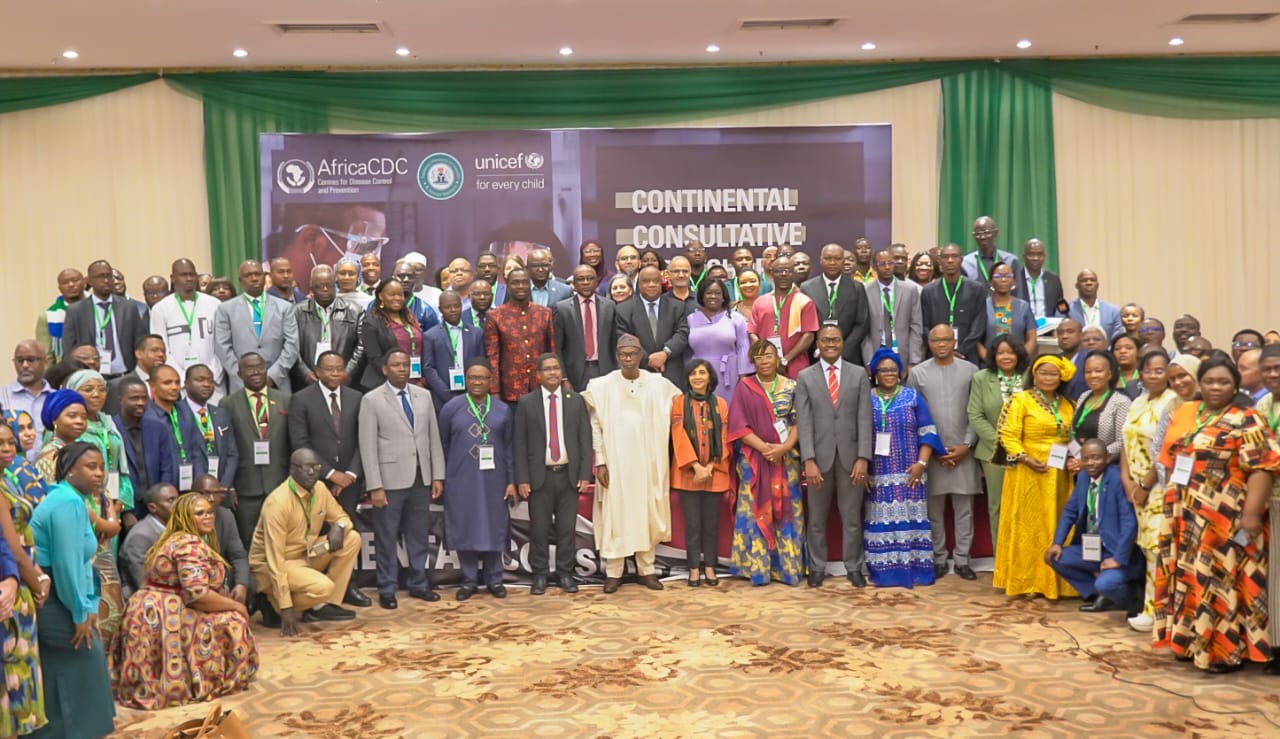
The Africa CDC, in collaboration with UNICEF and the African Union Commission, convened representatives from AU member states for the high-level consultation to validate findings from the 2024 Community Health Landscape Survey.
Participants include government representatives from AU member states, Africa CDC, African Union Commission, UNICEF, and health development partners.
Dr Tsague said ,” Community health workers should not be only volunteers. They should be remunerated. They should have a career path. They should be protected, and this is also a force for economic development in our countries.”
He said that primary health care should be prioritized through domestic financing and that within primary health care, the health workforce, particularly community health workers, should benefit to a large extent from domestic resources.
He said that the African Union Heads of State have been bold in their call for sustainable health financing, workforce strengthening, and mutual accountability—most notably through the Lusaka Agenda, which now serves as the guiding framework for domestically driven health sector investments.
“At the heart of the Lusaka Agenda lies the pivotal role of Community Health Workers (CHWs), who are the backbone of primary health care systems that are capable of delivering Universal Health Coverage (UHC) and fortifying our continent against current and future outbreaks, epidemics and pandemics,” he said.
He also said that Africa CDC remained fully committed to working with all member states and partners to institutionalize community health as the foundation of Africa’s health systems.
“Together, through coordinated efforts, data-driven action, and relentless advocacy, we can translate our shared vision into measurable impact—ensuring no community is left behind, and every frontline health worker is recognized, empowered, and supported,” he said.
He highlighted that the consultation meeting holds at an important moment for public health in Africa, when member states were facing significant financial constraints due to the reduction of development assistance to health.
He said it was also a critical moment because the continent continues to suffer from high burden of infectious disease outbreaks, and significant number of un-immunized children.
He said, “And within this context, the program of community health is a significant game changer, because our community health workers are the forefront. They are the front line of our primary health care. They will continue to be closer to our community, providing basic health services, providing prevention services, providing health promotion and providing continuity of care.”
Dr Tsague said the consultation meeting would enable health leaders across the continent to look at the progress that member states have achieved in pursuing the commitment of heads of state to have two million community health workers recruited, trained and deployed on the continent.
The Africa CDC Primary Health Care director said the Continental Community Health Landscape Survey offers the first comprehensive evidence base to assess and strategically strengthen community health systems across Africa.
“This consultation is a critical step in ensuring the data reflects the realities of our member states and serves as a robust tool for high-level political advocacy, policy prioritization, and resource allocation,” he stated.
He further said the findings of the landscape survey will reveal how far countries in the region have reached and what remains to achieve the two major targets.
” It will also allow our member states to indicate what are the critical challenges that deserves high level intervention of our heads of state,” he added.
He commended President Bola Ahmed Tinubu, saying that he is through his leadership showing the way in Nigeria about what has to be done to transform primary health care that accelerates the achievement of community health programs target.
The Minister of State for Health and Social Welfare, Federal Ministry of Health, Nigeria, Dr. Iziaq Adekunle Salako, said the large presence of delegates from different sister African countries reflected the shared and urgent commitment for a stronger, integrated, and people-centered health system anchored by community health delivery.
He said community health workers constitute the bridge through which health systems were connected to different communities where our people lives.
“They are the first line of defense, the advocates of preventive care, and the custodians of health education and community mobilization. It is therefore commendable that the African Union has recognised the critical role of CHWs in strengthening health systems and through the Africa CDC is implementing the New Public Health Order with CHWs as a key pillar,” he stated.
He said the COVID-19 pandemic taught Nigeria and the rest of the continent that community health systems were not a luxury but a necessity.
He said community health workers were first responders: mobilizing for immunization, driving health education, supporting surveillance, and reaching the unreached.
He said, “As such, their institutionalization, optimal deployment, adequate remuneration, and career pathways must be non-negotiable.
Nigeria proudly aligns with this vision, not only as a host but also as a nation on a determined path to reposition primary health care (PHC) as the cornerstone of its health system. ”
The minister said as part of the Renewed Hope Agenda of the President and the Health Sector Renewal Investment Initiative, Nigeria is implementing flagship initiatives like the Basic Health Care Provision Fund (BHCPF), the One Primary Health Care Centre Per Ward policy, and the expansion of the National Health Insurance Scheme, with community health workers at the heart of the initiatives.
He enjoined all delegates to see the consultation as a landmark opportunity to validate findings from the first-of-its-kind Continental Community Health Landscape Survey, use it to strengthen our country’s profiles, refine the community health workers framework, and co-create the community health scorecard; crucial tools for performance tracking, policy advocacy, and regional accountability.
He also urged them to use the outcomes of the consultation to directly feed into the work plan of the AU Champion on human resources for Health, defining milestones, high-level advocacy actions, and partner alignment strategies.
Wafaa Saeed UNICEF Nigeria Representative said
community-based primary health care, led by trained and dedicated community health workers, is transformative.
According to him, the approach has greatly reduced under-five mortality and expanded essential health services in countries like Rwanda, Malawi, and Ethiopia.
He said the economic benefits are compelling, adding that for every one dollar spent, the return on investment in community health exceeds ten dollars.
He said recent stocktaking shows growing political will, making the African Union’s vision of deploying two million community health workers achievable.
“With increased investment, including that from domestic contributions, an additional one million community health workers could be operational within three to four years, saving lives and strengthening systems,” he added.
The executive director of the National Primary Health Care Development Agency (NPHCDA) Dr. Muyi Aina, who was represented by Dr Joy Nwosu, said
NPHCDA in collaboration with states and partners has redesigned the community health program to provide more relevant services and delivered by professionalized community health workers.
He said this is necessary to address the challenges of integration with formal health care system and lack of ownership at the subnational level faced by the old CHIPS program.
He added that about 70,000 community health workers will be recruited, trained and deployed by 2029.
“One community health per 250 households, targeting 160 million people. NPHCDA will provide time-limited salary support that will enable states to recruit community health workers and transitioned them into the state’s civil service. In this regard, 8 states (Bauchi, Borno, Niger, Kaduna, Yobe, Zamfara, Katsina and Ebonyi) have signed the MoU framework while 5 states have started recruitment processes”, he added.