By Ojoma Akor
Kashima Iziaq Yusuf was convinced to get vaccinated for COVID-19 in 2021 because of the sensitization exercise carried out by the Nigerian Red Cross Society (NRCS) in Karshi community of Abuja, the Federal Capital Territory (FCT) of Nigeria.
She narrated that she was initially hesitant to take the COVID-19 vaccine due to the negative stories she heard about it.
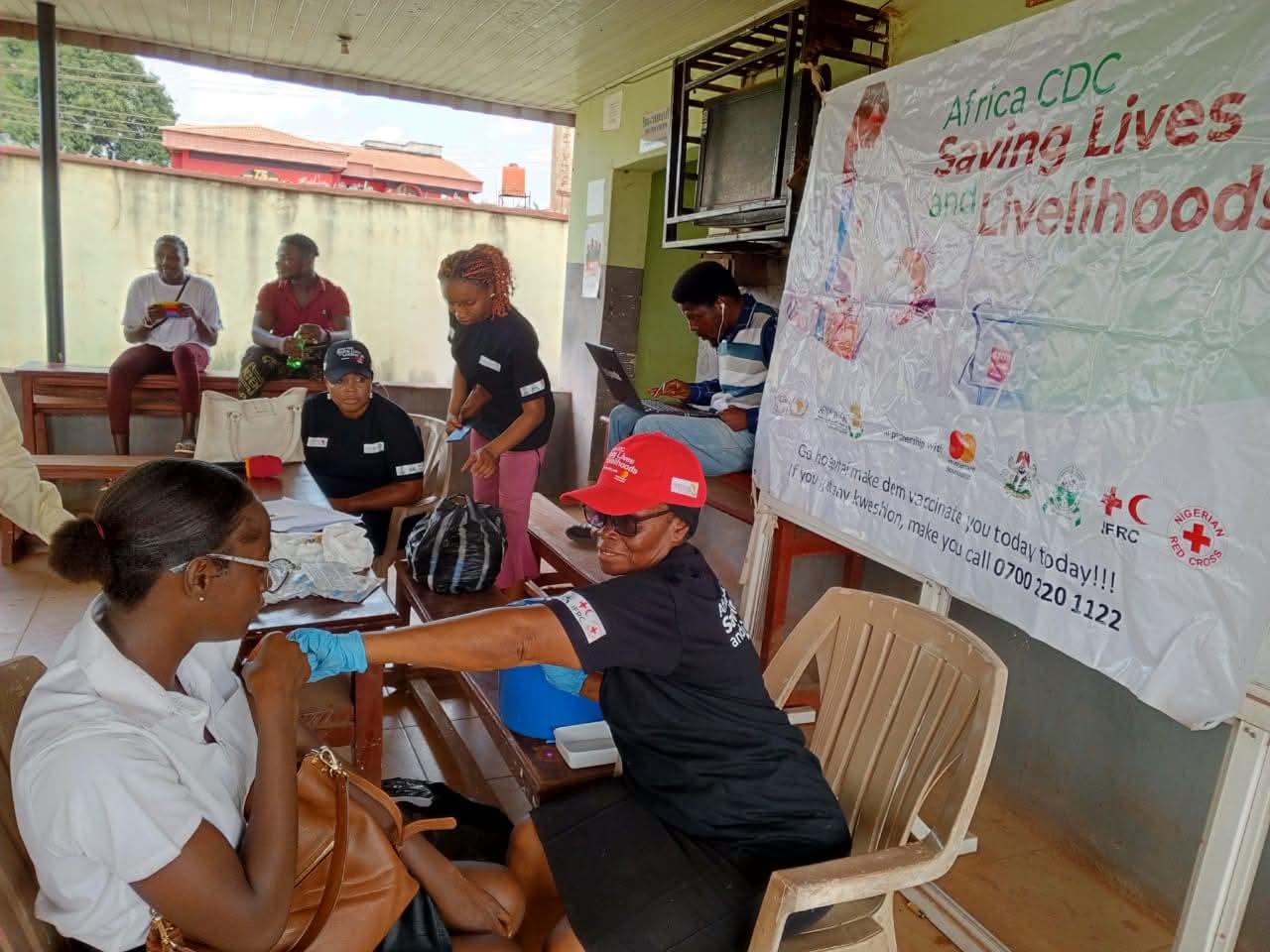
NRCS is one of the implementing partners of the Africa Centres for Disease Control and Prevention (Africa CDC)’ s Saving Lives and Livelihoods (SLL) programme in Nigeria.
Karshi, a growing satellite town in Abuja is one of the communities that benefitted from the Risk Communication and Community Engagement (RCCE) element of the first phase of SLL programme. NRCS is also part of the International Federation of the Red Cross (IFRC).
The SLL is a joint programme between the Africa CDC and the Mastercard Foundation designed to rapidly scale up COVID-19 vaccination on the continent with a target of achieving 70% coverage at the end of the project implementation period. SLL phase one launched in 2022.
“They told us that the vaccine is lifesaving, and that it can also boost our immune system to fight the disease,” Yusuf said.
She also went ahead to inform her family members, friends, neighbors and colleagues to get vaccinated.
She also advised them not to be afraid of the side effects of the COVID-19 vaccine.
“When I took the vaccine for the first time, my hand was a bit weak. But when I slept shortly thereafter, I woke up very strong. So, people in the community are now willing to go for vaccination for other diseases,”she added.
Another resident of the community, Ibrahim Mohammed Lawal, said he got vaccinated against COVID-19 following the SLL activity in the community. He also enlightened members of the community about the importance of COVID-19 vaccination.
“I told them the vaccine will protect them from getting COVID-19, and many of the residents got vaccinated. Before talking to them, I ensured that I also got vaccinated,” he said.
Alhaji Ahmed Doka, the district head of Karishi Central said people in the community were initially scared and hesitant to get vaccinated. But that the emirate’s council worked with a medical team to sensitize the people about COVID-19 vaccination.
“People were afraid to get vaccinated. But we the entire members of the palace took the vaccination, and we felt okay. Nobody got sick because of the vaccination,” he said.
“So, the emirate council members showed by example to the community, and urged them to take the vaccines. And the community began to get vaccinated. I also followed up. I asked them if they had any problem after taking the vaccine? Most of them said they felt normal. Only a few felt weak, but they also felt alright after some hours.”
Doka said residents of his community were now more open to vaccination against COVID-19 and other diseases, but he feels the expansion of the community health centre would allow for more health programs.
How the programme was implemented
According to Manir Jega, Director, Program and Partnership Development at the NRCS, the organization served as a vital auxiliary to the Nigerian government in the pandemic response.
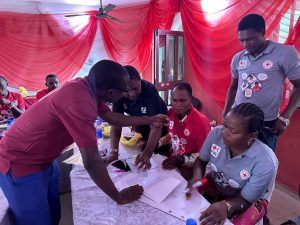
The implementation by NRCS spanned targeted advocacy, community engagement, media engagement (amplifying health messages), infection prevention and control (IPC), coordination and accountability – aligning action for collective impact, he said.
Impact across implementing states
Jega said the major achievements of the SLL program is that the NRCS supported the government of Nigeria in implementing the national RCCE strategy through targeted advocacy, community engagement, social media engagement and innovation and accountability.
“We were able to reach over eight million people and mobilized them for vaccination. Eight million people, that is a very good number, considering what the situation was during COVID-19,” he said.
Efforts to promote demand for the vaccines
Jega said enhanced coordination ensured message consistency and campaign quality, reinforcing vaccine demand and community trust.
He cited the success story in Nasarawa State where supportive supervision detected misinformation during door-to door visits, prompt correction restored confidence and prevented further hesitancy.
Summarizing the organization’s ACSM and RCCE contributions to demand generation, he said, over 8.5 million people were reached with RCCE messages, over 1000 supportive supervision visits recorded, 18 were languages used in media messaging, 6,800 volunteers mobilized for house-to house campaigns and 2,400 advocacy visits and over 800 Radio/TV Jingles aired and 3, 200 community alerts raised, among others.
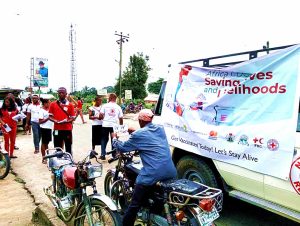
Chima Nwankwo, NRCS Coordinator of Communications and Advocacy on his part said people developed confidence in the vaccines when the NRCS team of the SLL programme cleared their doubts, and explained the details and possible side effects on them.
He said it also helped the country overcome the infodemic providing accurate and accessible COVID-19 information, especially for non-literate populations.
A success story was in Taraba where jingles broadcast in the Jukun language significantly reduced vaccine distrust in remote wards within two weeks, he narrated.
There were visible IPC measures at vaccine sites and built public confidence, thereby encouraging more people to present for COVID-19 vaccination.
Nwankwo also cited a success story in Kano State where enhanced IPC at a health facility led to a 40% drop-in infection rates, encouraging community members to seek care and vaccination there.
Challenges and lessons learnt
Despite achieving several successes, the programme has equally experienced some challenges. Jega said there were challenges in the implementation of phase one of the SLL programme by the NRCS. They ranged from issues with microplanning, coordination, payment of volunteers and interaction between government and implementing partners, among others.
He said that during the micro planning stage there were gaps as some of those that attended the various meetings were not the requisite experts for some components.
“For the micro planning, the technical group has pillars for RCCE, IPC, ACSM. information coming out should be specific, and invitation on who attends should be deliberate representation for each component.
Jega further said there is need for a platform for interaction among all partners.
“There was need for interaction outside the government especially at state level. A state has a coordination mechanism that should call all partners together to interact at all levels,” he said.
Yet, another challenge was that the government of Nigeria has no formal system of tracking the number of people reached with RCCE, he said, it only has a platform for tracking results like the number of people vaccinated.
This posed a challenge for NRCS during the implementation because it does not have corresponding data or platform comparable to government.
Jega said there were other challenges with payment of volunteers and network issues.
Also Lilian Adeogba , Senior Community Engagement and Accountability Project Manager SLL, International Federation of the Red Cross and Red Crescent, said the organization found out during state supportive visits that there was poor understanding about SLL phase one in some states.
She added that a lesson learnt from the implementation by NRCS is that proper advocacy and engagement should be done on time by government, Africa CDC and MasterCard Foundation.
On lessons learnt, Jega said the SLL programme phase one was implemented during an emergency but that for phase two, “things have become more stabilized, there is more time for planning, and adequate time for engagement of relevant stakeholders.”
” We are currently undergoing a rapid assessment to know where we are, and it will also inform us of the best strategy and approach to engage the people,”, Jega said, on the key successes for phase two implementation so far.
“For phase two there is no more volunteer engagement but more of capacity building, so we came up with specification on anyone we want to engage. There is no more volunteer engagement in phase two. But more of capacity building, so we came up with specifications on people we want to engage.”
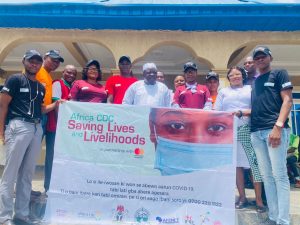
Dr Oluyinka Olayemi, national coordinator of the SLL programme for the Africa CDC in Nigeria said the Africa CDC SLL initiative in partnership with the Mastercard Foundation and in consultation with the Federal Ministry of Health through the National Primary Health Care Development Agency (NPHCDA) commenced programme implementation in Nigeria in August 2022 following series of engagement with the member state, implementing partners and stakeholders.
Oluyinka who led a delegation of Africa CDC team on a mission impact visit to Nigeria highlighted those areas of support to Nigeria include COVID-19 vaccination capacity, risk communication and community engagement, procurement and logistics.
She said implementing partners contracted by the funder, Master Card Foundation and supported by Africa CDCs technical assistance in Nigeria are IRESSEF for vaccination capacity, International Federation of the Red Cross (IFRC) for Risk Communication and Community Engagement (RCCE), UNICEF for procurement and logistics and IDI for implementation science.
She further explained that the RCCE component of the program, contracted to IFRC, is being implemented across the local branches across 36 states and the Federal Capital Territory (FCT) of Nigeria.
“IFRC and Nigeria Red Cross (NRC) conducted activities in partnership with the State Primary Health Care Development Agencies in their various branches,” she said.